The Schistosoma mansoni Phosphatome as a Frontier for Antischistosomal Drug Discovery: Molecular Functions, Target Validation and Therapeutic Perspectives
DOI:
https://doi.org/10.83080/rejost.vol6no8.336Keywords:
Schistosoma mansoni, Phosphatome, Protein phosphatases, Antischistosomal drug discovery, Target validation, Druggability, Phosphoproteomics, PraziquantelAbstract
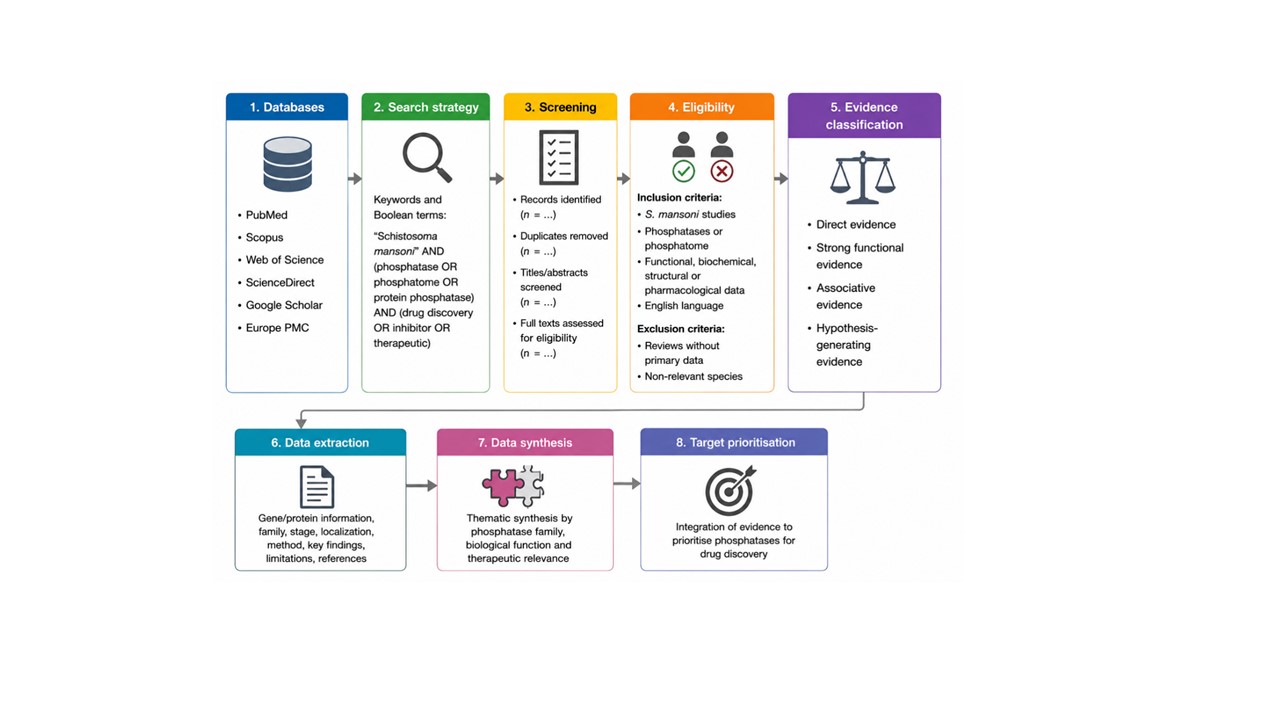
Schistosomiasis remains a major neglected tropical disease, affecting millions of people worldwide and causing substantial morbidity, particularly in endemic communities. Despite decades of control efforts, treatment still depends largely on praziquantel. Although the drug is highly effective against adult schistosomes, its activity against immature developmental stages is reduced, and it does not prevent reinfection. These limitations highlight the need for alternative therapeutic strategies. Protein phosphatases, which counterbalance protein kinases by regulating reversible phosphorylation, represent an important but comparatively neglected part of the Schistosoma mansoni drug-discovery landscape. The S. mansoni phosphatome includes diverse phosphatase families, such as serine/threonine phosphatases, protein tyrosine phosphatases, dual-specificity phosphatases, and metal-dependent phosphatases, with potential roles in signalling, development, metabolism, reproduction, stress responses, and parasite survival. The importance of phosphorylation-dependent regulation, together with the identification of essential phosphatases through functional genomic approaches, supports their consideration as potential therapeutic targets. Their catalytic domains, structural features, parasite-specific characteristics, and essential biological functions may offer opportunities for selective pharmacological intervention. Emerging approaches that combine RNA interference, phosphoproteomics, comparative genomics, structural bioinformatics, virtual screening, phenotypic screening, and biochemical target-engagement assays are making systematic target identification and validation in S. mansoni increasingly feasible. This review therefore examines the molecular functions and biological significance of the S. mansoni phosphatome, evaluates the evidence for phosphatase target validation and druggability, and discusses emerging strategies for inhibitor discovery. Finally, a translational framework linking phosphatase prioritisation, genetic and biochemical validation, structure-guided discovery, selective inhibitor development, and preclinical evaluation is proposed to help advance phosphatases from neglected regulatory enzymes to validated antischistosomal drug targets.
References
Aboagye, I. F., & Addison, Y. A. A. (2023). Praziquantel efficacy, urinary and intestinal schistosomiasis reinfection–a systematic review. Pathogens and Global Health, 117(7), 623-630.
Abou-El-Naga, I. F. (2025). Receptors for growth and development of Schistosoma mansoni. Journal of Helminthology, 99, e29.
Alli-Shaik, A., Wee, S., Lim, L. H., & Gunaratne, J. (2017). Phosphopro-teomics reveals network rewiring to a pro-adhesion state in annexin-1-deficient mammary epithelial cells. Breast Cancer Research, 19(1), 132.
Aula, O. P., McManus, D. P., Jones, M. K., & Gordon, C. A. (2021). Schistosomiasis with a focus on Africa. Tropical medicine and infectious disease, 6(3), 109.
Aulakh, S. K., Varma, S. J., & Ralser, M. (2022). Metal ion availability and homeostasis as drivers of metabolic evolution and enzyme function. Current opinion in genetics & development, 77, 101987.
Azevedo, C. M., Meira, C. S., da Silva, J. W., Moura, D. M. N., de Oliveira, S. A., da Costa, C. J., Santos, E. D. S., & Soares, M. B. P. (2023). Therapeutic potential of natural products in the treatment of schistosomiasis. Molecules, 28(19), 6807.
Banda, H., & Abere, A. (2025). Determining the mechanisms of praziquantel resistance in schistosomiasis: insights and future directions. Discover Medicine, 2(1), 105.
Brauer, B. L. (2022). Deciphering Phosphopro-tein Phosphatase Signaling Networks Using Proteomics Approaches (Doctoral dissertation, Dartmouth College).
Buonfrate, D., Ferrari, T. C. A., Adegnika, A. A., Stothard, J. R., & Gobbi, F. G. (2025). Human schistosomiasis. The Lancet, 405(10479), 658-670.
Cheng, S., Zhu, B., Luo, F., Lin, X., Sun, C., You, Y., Yi, C., Xu, B., Wang, J., Lu, Y., & Hu, W. (2022). Comparative transcriptome profiles of Schistosoma japonicum larval stages: Implications for parasite biology and host invasion. PLoS neglected tropical diseases, 16(1), e0009889.
Colley, D. G., Bustinduy, A. L., Secor, W. E., & King, C. H. (2014). Human schistosomiasis. The Lancet, 383(9936), 2253-2264.
Da’dara, A. A., Bhardwaj, R., Ali, Y. B., & Skelly, P. J. (2014). Schistosome tegumentalecto-apyrase (SmATPDase1) degrades exogenous pro-inflammatory and pro-thrombotic ucleotides. PeerJ, 2, e316.
Da’dara, A. A., Nation, C. S., & Skelly, P. J. (2024). Metabolism of FAD, FMN and riboflavin (vitamin B2) in the human parasitic blood fluke Schistosoma mansoni. BMC Infectious Diseases, 24(1), 636.
Daher, W., Cailliau, K., Takeda, K., Pierrot, C., Khayath, N., Dissous, C., Capron, M., Yanagida, M., Browaeys, E., & Khalife, J. (2006). Characterization of Schistosoma mansoni Sds homologue, a leucine-rich repeat protein that interacts with protein phosphatase type 1 and interrupts a G2/ M cell - cycle checkpoint. Biochemical Journal, 395(2), 433-441.
Dayanc, B., Eris, S., Gulfirat, N. E., Ozden-Yilmaz, G., Cakiroglu, E., Coskun Deniz, O. S., Karakülah, G., Erkek-Ozhan, S., & Senturk, S. (2025). Integrative multi-omics identifies AP-1 transcription factor as a targetable mediator of acquired osimertinib resistance in non-small cell lung cancer. Cell Death & Disease, 16(1), 414.
De Roo, C., McLean, E., & Liu, R. (2025). Dual-specificity phosphatases: An update on their activity regulation and roles in metabolic diseases. Current Opinion in Physiology, 44, 100816.
Eastham, G., Fausnacht, D., Becker, M. H., Gillen, A., & Moore, W. (2024). Praziquantel resistance in schistosomes: a brief report. Frontiers in parasitology, 3, 1471451.
Fan, X., Zhou, C., Zhang, P., & Ming, Y. (2026). Effects of Different Living Environ-ments on Intestinal Flora in Patients with Schistosoma Japonicum‐Induced Liver Fibrosis. Micro-biologyOpen, 15(4), e70366.
Freire, C. F., Souza-Lopes, T., Amaral, M. S., Tahira, A. C., & Verjovski-Almeida, S. (2026). Comprehensive Schistosoma mansoni Hierarchical Transcriptome Assembly Points to Novel lncRNAs Associated with Sexual Dimorphism. Non-coding RNA, 12(2), 9.
Freitas-Mesquita, A. L., & Meyer-Fernandes, J. R. (2026). Phosphate Acquisition in Protozoan Parasites: Transport Systems, and Extracellular Phosphate-Releasing Enzymatic Activities. International Journal of Molecular Sciences, 27(9), 3707.
Fréville, A., Gnangnon, B., Khelifa, A. S., Gissot, M., Khalife, J., & Pierrot, C. (2022). Deciphering the role of protein phosphatases in apicomplexa: the future of innovative therapeutics? Microorganisms, 10(3), 585.
Gomes, B. F., Senger, M. R., Moreira-Filho, J. T., Vasconcellos, F. J. D., Dantas, R. F., Owens, R., Andrade, C. H., Neves, B. J., & Silva-Junior, F. P. (2023). Discovery of new Schistosoma mansoni aspartyl protease inhibitors by structure-based virtual screening. Memórias do Instituto Oswaldo Cruz, 118, e230031.
Hirst, N. (2019). Schistosoma mansoni: integration of phosphoproteomics, kinomics and CaMKII (Doctoral dissertation, Kingston University).
Hirst, N. L., Lawton, S. P., & Walker, A. J. (2022). CaMKII regulates neuromuscular activity and survival of the human blood fluke Schistosoma mansoni. Scientific Reports, 12 (1), 19831.
Hirst, N. L., Nebel, J. C., Lawton, S. P., & Walker, A. J. (2020). Deep phosphoproteome analysis of Schistosoma mansoni leads development of a kinomic array that highlights sex-biased differences in adult worm protein phosphorylation. PLoS neglected tropical diseases, 14 (3), e0008115.
Kamara, I. K., Thao, J. T., Kaur, K., Wheeler, N. J., & Chan, J. D. (2023). Annotation of G - protein coupled receptors in the genomes of parasitic blood flukes. microPublication Biology, 2023, 10-17912.
Ke, D. T., Zhan, Z., Zhang, W., Hu, Z., & Chen, P. H. (2026). Deciphering phosphorylation TACtics: Advances in phosphorylation targeting strategies and bifunctional modalities. Cell Chemical Biology, 33(2), 153-168.
Ku, B. (2025). Structural analysis of dual specificity phosphatases, the only type of protein tyrosine phosphatases found in humans and across diverse microorganisms. Journal of Micro-biology, 63(10), e2506006.
Li, X., Weth, O., Haeberlein, S., & Grevelding, C. G. (2023). Molecular characterization of Sm tdc-1 and Sm ddc-1 discloses roles as male-competence factors for the sexual maturation of Schistosoma mansoni females. Frontiers in cellular and infection microbiology, 13, 1173557.
Marhöfer, R. J., Noack, S., & Selzer, P. M. (2025). Antiparasitics discovery from genotype to phenotype to compounds. Trends in Parasitolo-gy, 41(6), 431-440.
Mawa, P. A., Kincaid-Smith, J., Tukahebwa, E. M., Webster, J. P., & Wilson, S. (2021). Schistosomiasis morbidity hotspots: roles of the human host, the parasite and their interface in the development of severe morbidity. Frontiers in immunology, 12, 635869.
Mtemeli, F. L., Ndlovu, J., Mugumbate, G., Makwikwi, T., & Shoko, R. (2022). Advances in schistosomiasis drug discovery based on natural products. All Life, 15(1), 608-623.
Mughal, M. N. (2022). Characterization of the autophagy machinery in Schistosoma mansoni, a parasite of public health relevance (Doctoral dissertation, Disser-tation, Gießen, Justus-Liebig-Universität Gießen, 2022).
N’Guessan-Koffi, C., De Witte, C., Franetich, J. F., Farce, A., Peucelle, V., Silvie, O., Toure, S., Marion, S., Gnangnon, B., Freville, A., Khalife, J., & Aliouat, E. M. (2026). Molecular and cellular characterization of Plasmodium berghei PPM9 phosphatase, an enzyme dispensable during both asexual and sexual life cycle stages. Scientific Reports.
Nath, B., Chakraborty, S., & Biswas, S. (2026). PEG400 regulates Falcipain 2 activity through an allosteric mechanism. The FEBS Journal.
Odugbemi, A. I., Mthembu, W., &Zininga, T. (2026). Exploiting ER proteostasis in malaria: protein disulphide isomerases as selective antimalarial targets. Expert Opinion on Therapeutic Target.
Onyekwere, A. (2022). Population genetic structure and hybridization of urogenital schistosomiasis among primary school-age pupils in Nigeria. Doctoral dissertation, Université de Perpignan.
Padalino, G., Coghlan, A., Pagliuca, G., Forde-Thomas, J. E., Berriman, M., & Hoffmann, K. F. (2023). Using ChEMBL to complement schistosome drug discovery. Pharmaceutics, 15(5), 1359.
Page, M. J., McKenzie, J. E., Bossuyt, P. M., Boutron, I., Hoffmann, T. C., Mulrow, C. D., Shamseer, L., Tetzlaff, J. M., Akl, E. A., Brennan, S. E., Chou, R., & Moher, D. (2021). The PRISMA 2020 statement: an updated guideline for reporting systematic reviews. bmj, 372.
Pereira Moreira, B., Weber, M. H., Haeberlein, S., Mokosch, A. S., Spengler, B., Grevelding, C. G., & Falcone, F. H. (2022). Drug repurposing and de novo drug discovery of protein kinase inhibitors as new drugs against schistosomiasis. Molecules, 27(4), 1414.
Perla, S., Pascale, J., Liu, M., Kumar, A., Kuppuswamy, S., Alladi, C. G., & Samara, V. A. (2026). Protein Tyrosine Phosphatases in Cancer: From Oncogenic Drivers to Therapeutic Targets.
Rinaldi, G., Paz Meseguer, C., Cantacessi, C., & Cortés, A. (2024). Form and Function in the Digenea, With an Emphasis on Host–Parasite and Parasite–Bacteria Interactions. Digenetic Trematodes, 3-45.
Satala, D., Kowalik, K., &Karkowska-Kuleta, J. (2026). Cell surface shaving-based proteomic profiling of the surfaceome in pathogenic microorganisms. International Journal of Molecular Sciences, 27(2), 1048.
Selzer, P. M. (2013). Protein Phosphorylation in Parasites: Novel Targets for Antiparasitic Intervention. John Wiley & Sons.
Skelly, P. J., & Da’dara, A. A. (2025). Expression, characterization and selective chemical inhibition of essential Schistosoma mansoni tegumental acetyl-cholinesterase SmTAChE). International Journal of Molecular Sciences, 26(5), 1975.
Slovakova, M., &Bilkova, Z. (2021). Contemporary Enzyme-Based methods for Recombinant proteins in vitro phosphorylation. Catalysts, 11(8), 1007.
Stephens, D. R., Fung, H. Y. J., Han, Y., Liang, J., Chen, Z., Ready, J., & Collins III, J. J. (2025). A genome-scale drug discovery pipeline uncovers therapeutic targets and a unique p97 allosteric binding site in Schistosoma mansoni. Proceedings of the National Academy of Sciences, 122(35), e2505710122.
Thiriet, M. (2012). Cytosolic Protein Phosphatases. In Intracellular Signaling Mediators in the Circulatory and Ventilatory Systems (pp. 387-463). New York, NY: Springer New York.
Tuazon, J. A. (2024). The Ikaros zinc finger transcription factor Eos as a novel regulator of STAT5 phosphorylation in CD4+ T helper cells. The Ohio State University.
Villamizar-Monsalve, M. A., López-Abán, J., Vicente, B., Peláez, R., & Muro, A. (2024). Current drug strategies for the treatment and control of schistosomiasis. Expert Opinion on Pharmacotherapy, 25(4), 409-420.
Walker, A. J., Rinaldi, G., & Shakir, E. M. (2025). Molecular interactions between male and female schistosomes–a role for remote communication? Trends in Parasitology, 41(1), 28-37.
World Health Organization. (2026). Schistosomiasis. https://www.who.int/-news-room/fact-sheets/detail/schistos-omiasis
Wu, L., Xu, H., Zhang, X., Zhang, M., Xu, Y., Zhang, Q., Tao, H., Dong, C., Zhang, X., Zhou, M., Yang, J., & Song, Q. (2025). Integrated proteomics and phosphoproteomics profiling dynamic signaling networks underlying two distinct types of macrophage activation. Cellular Immunology, 413, 104972.
Zhong, Q., Xiao, X., Qiu, Y., Xu, Z., Chen, C., Chong, B., Zhao, X., Hai, S., Li, S., An, Z. & Dai, L. (2023). Protein posttranslational modifications in health and diseases: Functions, regulatory mechanisms, and therapeutic implications. MedComm, 4(3), e261.
Downloads
Published
How to Cite
Issue
Section
License
Copyright (c) 2026 A. O. Sulyman

This work is licensed under a Creative Commons Attribution-NonCommercial-ShareAlike 4.0 International License.
Unless a different licence is clearly indicated for a particular article, articles published in the journal are made available under the Creative Commons Attribution 4.0 International (CC BY 4.0) licence. This licence permits others to read, download, copy, distribute, share, adapt, and build upon the published work, including for commercial purposes, provided that appropriate credit is given to the original author(s), the article is properly cited, and any changes made to the original work are clearly indicated.