Prof. Nyakno J. George
Department of Physics
Akwa Ibom State University, Nigeria
Profile
Editorial Policy
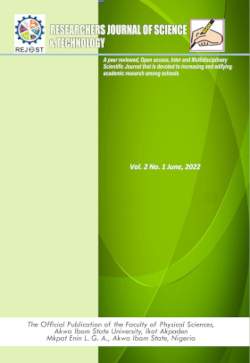
Researchers Journal of Science and Technology
Published by the Faculty of Physical Sciences, Akwa Ibom State University, Nigeria
- Introduction
The Researchers Journal of Science and Technology is a scholarly, peer-reviewed journal published by the Faculty of Physical Sciences, Akwa Ibom State University. The journal provides a platform for the publication and dissemination of high-quality research in science, technology, and related interdisciplinary fields.
The journal is committed to promoting sound scientific inquiry, originality, transparency, academic integrity, and responsible research communication. Its editorial policy is designed to ensure that all manuscripts are assessed fairly, rigorously, and objectively, while maintaining the highest standards of scholarly publishing.
The journal welcomes contributions from researchers, academics, professionals, and postgraduate students from Akwa Ibom State University, Nigeria, and the wider international research community.
- Aims and Scope
The journal publishes original research articles, review papers, short communications, technical notes, methodological papers, and other scholarly contributions that advance knowledge in science and technology.
The scope of the journal includes, but is not limited to:
- Physics and applied physics;
- Chemistry and related disciplines;
- Mathematics and statistics;
- Computer science and information technology;
- Geology and geophysics;
- Environmental and atmospheric sciences;
- Materials science;
- Biotechnology and related technological fields;
- Renewable energy and energy technology;
- Earth and environmental sciences;
- Data science, modelling, and computational methods; and
- Interdisciplinary research involving the physical sciences and technology.
The journal particularly encourages research that addresses relevant scientific, environmental, technological, and societal challenges, especially those affecting Nigeria, Africa, and the wider global community.
- Editorial Independence
Editorial decisions are based primarily on the scientific quality, originality, relevance, methodological soundness, and ethical standing of submitted manuscripts.
The editorial process is conducted independently of commercial, political, personal, or institutional influence. The affiliation of an author, the seniority of the researcher, the perceived prestige of an institution, or the nationality of an author shall not determine the editorial decision.
Editors are expected to make decisions objectively and to declare any situation that may constitute a conflict of interest.
- Originality and Contribution to Knowledge
Manuscripts submitted to the journal must present original work that has not been published previously and is not under consideration for publication elsewhere.
Authors are expected to clearly demonstrate the contribution of their work to existing knowledge. A manuscript should not merely repeat established findings without providing a meaningful scientific, methodological, theoretical, or practical contribution.
Where a manuscript is based on data, ideas, methods, or findings previously reported by the authors or other researchers, the relevant sources must be properly acknowledged.
- Submission of Manuscripts
Manuscripts must be submitted in accordance with the journal's prescribed author guidelines. The submission should contain sufficient information to enable editors and reviewers to assess the scientific quality and relevance of the work.
Authors are responsible for ensuring that:
- The manuscript is prepared according to the journal's formatting requirements.
- All authors who made substantial contributions to the work are appropriately listed.
- All listed authors have approved the submitted version of the manuscript.
- The manuscript is not simultaneously under consideration by another journal.
- All sources of information, data, figures, tables, and ideas obtained from other works are properly acknowledged.
- The research complies with relevant ethical, institutional, professional, and regulatory requirements.
The journal may reject manuscripts that fall outside its scope, fail to meet minimum scholarly standards, or contain serious ethical or methodological concerns before external peer review.
- Peer-Review Policy
The journal uses a rigorous peer-review process to evaluate the scientific quality and relevance of submitted manuscripts.
Depending on the nature of the manuscript and the circumstances of the review, the journal may use single-blind, double-blind, or another appropriate form of peer review. The specific review procedure may be determined by the Editorial Board.
Reviewers are expected to assess manuscripts objectively and provide constructive comments that can assist authors in improving their work. Reviewers should evaluate the following, among other considerations:
- Originality and significance of the research;
- Clarity of the research objectives;
- Adequacy of the methodology;
- Reliability and interpretation of the data;
- Appropriateness of statistical or analytical procedures;
- Quality of the discussion and conclusions;
- Relevance and accuracy of cited literature;
- Clarity of presentation; and
- Compliance with ethical standards.
Reviewers should not use information obtained during the review process for personal advantage or for the benefit of others.
- Editorial Decisions
Editorial decisions may include:
- Accept;
- Accept subject to minor revision;
- Revise and resubmit;
- Major revision required;
- Reject and resubmit as a new manuscript; or
A decision to reject a manuscript does not necessarily imply that the research is without value. It may indicate that the manuscript does not meet the journal's current standards, falls outside the journal's scope, has substantial methodological limitations, or requires more extensive development than can reasonably be addressed through revision.
Editorial decisions are made on the basis of the manuscript and the available scholarly evidence, not on the personal characteristics of the authors.
- Responsibilities of Editors
Editors are responsible for managing the editorial process fairly, efficiently, and transparently.
Editors shall:
- Treat all submitted manuscripts confidentially;
- Select suitable and independent reviewers;
- Make editorial decisions based on scholarly merit;
- Avoid discrimination based on nationality, gender, ethnicity, institutional affiliation, religion, or other personal characteristics;
iDeclare and appropriately manage conflicts of interest;
- Protect the integrity of the peer-review process; and
- Take appropriate action when ethical concerns arise.
Editors should not participate in decisions concerning manuscripts in which they have a personal, professional, financial, or institutional interest.
- Responsibilities of Reviewers
Reviewers play an important role in maintaining the scientific quality of the journal.
Reviewers are expected to:
- Accept assignments only when they possess appropriate expertise;
- Complete reviews within the agreed period or promptly inform the editor if this is not possible;
- Maintain the confidentiality of the manuscript;
- Provide fair, respectful, and evidence-based comments;
- Identify relevant published work that has not been appropriately cited where necessary;
- Alert the editor to possible plagiarism, duplicate publication, fabricated data, or other ethical concerns; and
- Declare any conflict of interest before accepting the review.
Reviewers should not contact authors directly about a manuscript under review unless authorized by the editor.
- Responsibilities of Authors
Authors are responsible for the accuracy, originality, and integrity of their work.
Authors must:
- Present their research accurately and honestly;
- Ensure that reported data are reliable and not fabricated or manipulated;
- Describe methods clearly enough to permit appropriate evaluation and, where possible, replication;
- Provide appropriate access to supporting data when reasonably required;
- Cite relevant sources accurately;
- Disclose any conflicts of interest;
- Acknowledge financial and institutional support;
- Obtain the necessary ethical or institutional approvals where applicable; and
- Correct significant errors discovered after publication.
Authorship should be limited to individuals who made substantial contributions to the conception, design, execution, analysis, or interpretation of the research, or who made significant contributions to the preparation and critical revision of the manuscript.
Individuals who provided only administrative support, general supervision, funding, or minor assistance should not be listed as authors unless their contribution meets the accepted standards of authorship.
- Research Integrity and Ethical Conduct
The journal has a zero-tolerance approach to serious forms of research misconduct.
Research misconduct includes, but is not limited to:
- Fabrication of data or results;
- Falsification or manipulation of data, images, or research procedures;
- Plagiarism;
- Duplicate publication;
- Unethical authorship practices;
- Undisclosed conflicts of interest;
- Manipulation of the peer-review process; and
- Misrepresentation of research findings.
Where allegations of misconduct arise, the journal will assess the matter carefully and may seek clarification from the authors, their institutions, or other appropriate bodies.
Where necessary, the journal may issue a correction, expression of concern, retraction, or other appropriate editorial notice.
- Plagiarism and Similarity
All submitted manuscripts may be screened for plagiarism and excessive textual similarity.
The use of another person's words, ideas, data, figures, or intellectual contributions without appropriate acknowledgment is unacceptable. Authors are expected to paraphrase responsibly, quote appropriately where necessary, and cite all relevant sources.
Similarity reports are not interpreted mechanically. The Editorial Board considers the nature, location, extent, and context of any identified similarity before making an editorial decision.
- Duplicate and Simultaneous Submission
A manuscript submitted to the journal must not be under consideration by another journal at the same time.
The submission of the same manuscript to multiple journals is considered unacceptable because it can waste editorial and reviewer resources and may result in duplicate publication.
Authors must disclose any closely related manuscript, conference paper, preprint, thesis, or previous publication that may overlap substantially with the submitted work.
- Corrections, Retractions, and Expressions of Concern
The journal is committed to maintaining an accurate scholarly record.
Corrections may be published when an error affects the accuracy or interpretation of a published article but does not invalidate the main findings.
A retraction may be considered where there is clear evidence of serious problems such as fabricated or falsified data, major methodological errors, plagiarism, or substantial ethical violations.
An expression of concern may be issued when serious questions have arisen about a publication but the investigation has not yet been completed.
Any editorial action will be taken carefully and, where appropriate, in consultation with the authors and relevant institutions.
- Conflicts of Interest
Authors, editors, and reviewers must disclose any financial, professional, personal, or institutional relationship that could reasonably influence their judgment.
A conflict of interest does not automatically prevent publication or participation in peer review. However, undisclosed conflicts that could affect the integrity of the editorial process may lead to further investigation or appropriate editorial action.
- Funding and Acknowledgement of Support
Authors should clearly acknowledge all sources of financial, institutional, technical, or other significant support received for the research.
Where appropriate, authors should state the role of the funding organization in the design of the study, data collection, analysis, interpretation, and preparation of the manuscript.
- Use of Artificial Intelligence and Generative Tools
Authors may use artificial intelligence and other digital tools to assist with language improvement, data analysis, coding, or other legitimate aspects of research, provided that their use does not compromise the originality, accuracy, transparency, or integrity of the work.
Artificial intelligence tools cannot be listed as authors because they cannot take responsibility for the content of a manuscript.
Authors remain fully responsible for:
- The accuracy of all information in the manuscript;
- The originality of the work;
- Verification of references and citations;
- Protection of confidential or sensitive information; and
- Disclosure of significant use of artificial intelligence where such use materially contributed to the research or manuscript preparation.
AI-generated content must not be used to fabricate data, invent references, manipulate results, or misrepresent scientific evidence.
- Data, Methods, and Reproducibility
The journal encourages authors to provide sufficient methodological detail to allow readers to understand, evaluate, and, where reasonably possible, reproduce the research.
Authors are encouraged to make relevant datasets, analytical procedures, codes, models, and supplementary materials available when ethical, legal, institutional, and practical considerations permit.
Any limitations relating to data availability, sampling, instrumentation, analytical procedures, or reproducibility should be clearly acknowledged.
- Human, Animal, and Environmental Research
Research involving human participants, animals, sensitive environmental resources, or other regulated subjects must comply with relevant ethical, institutional, and legal requirements.
Where applicable, authors must provide information regarding ethical approval, informed consent, permits, or other required authorizations.
The journal will not knowingly publish research that violates accepted ethical standards or relevant regulatory requirements.
- Appeals and Complaints
Authors who believe that an editorial decision was made as a result of a significant misunderstanding, procedural error, or inappropriate consideration may submit a formal appeal to the Editor-in-Chief.
An appeal should clearly state the grounds for the appeal and provide specific evidence supporting the request for reconsideration.
Disagreement with the scientific judgment of reviewers alone may not be sufficient grounds for overturning an editorial decision.
Complaints concerning editorial conduct, publication ethics, or the review process should be addressed to the Editor-in-Chief or the appropriate editorial authority.
All complaints and appeals will be considered fairly and, where possible, resolved in a timely manner.
- Publication Ethics and Transparency
The journal is committed to transparency throughout the publication process. Editorial policies may be reviewed periodically to reflect developments in scholarly communication, research ethics, publishing standards, and technological change.
The journal also recognizes that maintaining research integrity is a shared responsibility. Authors, reviewers, editors, institutions, and publishers all have important roles in protecting the reliability and credibility of the scientific record.
- Editorial Responsibility
The Editorial Board reserves the right to make final decisions concerning the acceptance, revision, rejection, correction, or retraction of manuscripts published in the journal.
In exercising this responsibility, the Board shall seek to balance academic freedom with the need to maintain rigorous scientific and ethical standards.
The ultimate goal of the Researchers Journal of Science and Technology is to provide a credible and accessible platform through which researchers can communicate reliable knowledge, engage with emerging scientific ideas, and contribute meaningfully to the advancement of science and technology.
The journal is committed to a simple principle: sound science, honest scholarship, fair evaluation, and responsible dissemination of knowledge