Prof. Nyakno J. George
Department of Physics
Akwa Ibom State University, Nigeria
Profile
Ethical and Malpractice Policy
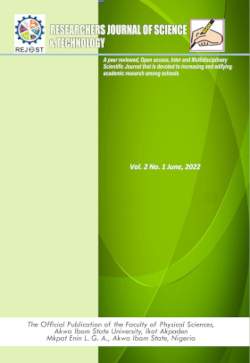
Researchers Journal of Science and Technology
Faculty of Physical Sciences, Akwa Ibom State University, Nigeria
The Researchers Journal of Science and Technology is committed to maintaining the highest standards of integrity, transparency, fairness, and accountability in scholarly publishing. The journal recognizes that the credibility of scientific research depends not only on the quality of the research itself but also on honesty throughout the processes of research, manuscript preparation, peer review, editorial decision-making, and publication.
This policy provides guidance for authors, reviewers, editors, and other individuals involved in the publication process. It is intended to prevent research misconduct and ensure that all manuscripts published by the journal meet acceptable ethical and professional standards.
- Responsibilities of Authors
Authors are expected to conduct and report their research honestly, accurately, and transparently. By submitting a manuscript, authors confirm that the work is their own and that the information presented is truthful and properly reported.
Authors must:
- ensure that the submitted work is original and has not been published elsewhere;
- submit only one version of a manuscript to the journal at a time;
- accurately report the methods, data, results, and conclusions of the research;
- provide sufficient information to enable the work to be understood and, where appropriate, reproduced;
- properly acknowledge all sources, ideas, data, methods, and materials obtained from other researchers;
- obtain permission where copyrighted material or substantial material belonging to others is used;
- disclose all sources of financial support and any potential conflicts of interest;
- ensure that all listed authors have made substantial contributions to the research or manuscript;
- obtain the approval of all co-authors before submitting a manuscript;
- promptly inform the Editor-in-Chief of any significant error discovered in a published or submitted manuscript.
Authors must not knowingly submit false, fabricated, or misleading information.
- Authorship and Contributorship
Authorship should reflect genuine and substantial contributions to the conception, design, execution, analysis, or interpretation of the research, as well as meaningful participation in the preparation or critical revision of the manuscript.
Individuals who have made substantial contributions should be appropriately recognized as authors. Conversely, individuals who have not made a meaningful contribution should not be listed as authors.
The journal does not permit:
- ghost authorship, where a person who made a substantial contribution is excluded from authorship;
- guest or honorary authorship, where a person is listed as an author without making a meaningful contribution;
- gift authorship, where authorship is given as a favour or for personal, institutional, or professional reasons.
Any change in authorship after submission must be justified and approved by all authors concerned. The Editor-in-Chief may request written confirmation from all authors before approving such a change.
- Plagiarism and Duplicate Publication
Plagiarism is considered a serious violation of research and publishing ethics. It includes presenting another person's words, ideas, data, figures, results, or intellectual contributions as one's own without proper acknowledgement.
The journal also considers the following forms of misconduct unacceptable:
- direct copying of text without appropriate quotation and citation;
- substantial paraphrasing without acknowledgement;
- presenting another researcher's ideas or findings as original;
- self-plagiarism involving the substantial reuse of one's previously published work without appropriate citation or disclosure;
- submitting substantially similar manuscripts to more than one journal at the same time;
- publishing the same research in more than one journal without proper justification and disclosure;
- dividing one research project into several publications solely to increase the number of publications without sufficient scientific justification.
Manuscripts suspected of plagiarism or duplicate publication may be screened and investigated. Where misconduct is confirmed, appropriate action may include rejection of the manuscript, withdrawal of the article, publication of a correction or retraction, and notification of the relevant institution where necessary.
- Fabrication, Falsification, and Manipulation of Data
The journal has zero tolerance for the fabrication or falsification of research data.
Fabrication involves making up data, results, observations, experiments, or research records that never existed.
Falsification involves manipulating research materials, equipment, processes, data, images, or results in a manner that misrepresents the research findings.
Unacceptable practices include:
- inventing observations, measurements, samples, or experimental results;
- selectively removing or altering data to support a preferred conclusion;
- manipulating images or figures in a way that changes their scientific meaning;
- misrepresenting research procedures or analytical methods;
- reporting results that were not actually obtained.
Minor, clearly disclosed adjustments made for legitimate scientific purposes, such as image enhancement for clarity, must not alter or misrepresent the underlying information.
- Ethical Conduct of Research
Authors are responsible for ensuring that their research complies with applicable ethical, institutional, national, and international standards.
Where research involves human participants, animals, sensitive personal information, or potentially harmful activities, authors should obtain approval from the appropriate ethics committee or institutional review body where required. Relevant ethical approval details should be included in the manuscript.
Authors must ensure that participants are treated with dignity, fairness, and respect. Where applicable, informed consent should be obtained and confidentiality and privacy should be protected.
Research involving environmental samples, field investigations, hazardous materials, or potentially harmful procedures must comply with relevant safety, environmental, and institutional requirements.
- Data Availability and Research Transparency
Authors are encouraged to retain accurate research records and supporting data for a reasonable period after publication.
Where appropriate and subject to ethical, legal, privacy, or confidentiality restrictions, authors should make relevant data, analytical procedures, software, models, or other supporting materials available to enable verification of the research.
Where data cannot be shared, authors should clearly state the reason, such as confidentiality, privacy, legal restrictions, or restrictions imposed by a third party.
- Conflicts of Interest
Authors, reviewers, and editors must disclose any financial, professional, personal, institutional, or other relationship that could reasonably influence—or appear to influence—their judgment.
Potential conflicts may include:
- financial support or sponsorship;
- employment or consultancy relationships;
- personal or professional relationships;
- institutional competition or rivalry;
- ownership of patents or commercial interests;
- personal interests that may influence the interpretation of results.
The existence of a conflict of interest does not automatically prevent publication or participation in peer review. However, relevant conflicts must be disclosed so that they can be properly managed.
- Responsibilities of Reviewers
Peer reviewers play an important role in maintaining the quality and integrity of the journal. Reviewers are expected to evaluate manuscripts objectively, fairly, confidentially, and within the agreed timeframe.
Reviewers should:
- assess manuscripts solely on the basis of their scientific quality, originality, relevance, clarity, and methodological soundness;
- provide constructive and respectful comments;
- avoid personal criticism of authors;
- maintain the confidentiality of all information contained in the manuscript;
- not use unpublished information obtained during peer review for personal advantage or to benefit another person;
- disclose any conflict of interest before accepting an invitation to review;
- decline the review if they lack the necessary expertise or cannot provide an impartial assessment;
- inform the editor if they suspect plagiarism, duplicate publication, fabricated data, or other forms of misconduct.
Reviewers must not contact authors directly about a manuscript under review unless authorized by the journal.
- Responsibilities of Editors
Editors are responsible for ensuring that editorial decisions are made fairly, independently, and transparently.
Editors must:
- evaluate manuscripts based on scholarly merit and relevance to the journal;
- avoid discrimination based on gender, ethnicity, nationality, religion, institutional affiliation, political views, or other personal characteristics;
- maintain the confidentiality of submitted manuscripts;
- manage conflicts of interest appropriately;
- select suitable and independent reviewers;
- protect the integrity of the peer-review process;
- investigate credible allegations of research or publication misconduct;
- correct the scholarly record when errors or misconduct are confirmed.
Editorial decisions should not be influenced by commercial interests, personal relationships, institutional pressure, or the identity of the authors.
- Peer-Review Manipulation
The journal considers peer-review manipulation to be serious misconduct. This includes:
- submitting false or misleading reviewer identities;
- suggesting reviewers who have undisclosed personal or professional relationships with the authors;
- attempting to influence reviewers improperly;
- creating or using fabricated reviewer accounts;
- interfering with the normal peer-review process.
Where peer-review manipulation is suspected, the journal may suspend the review or publication process and conduct an investigation.
- Use of Artificial Intelligence and Other Digital Tools
Authors may use artificial intelligence and other digital tools to assist with language improvement, grammar correction, data analysis, or other legitimate research-support activities, provided that such use does not compromise the originality, accuracy, or integrity of the work.
Artificial intelligence tools must not be listed as authors because they cannot accept responsibility for the content of a manuscript.
Authors remain fully responsible for:
- the accuracy of all information in the manuscript;
- the originality of the work;
- the proper citation of sources;
- the verification of any information generated or assisted by artificial intelligence;
- ensuring that confidential or sensitive research information is not improperly disclosed to external tools.
The use of artificial intelligence should be disclosed where it has made a substantive contribution to the research, analysis, or preparation of the manuscript.
- Corrections, Retractions, and Withdrawal of Articles
The journal recognizes its responsibility to maintain an accurate and reliable scholarly record.
A correction may be issued when a published article contains an error that does not invalidate the main findings of the work.
A retraction may be issued when an article contains serious errors, unreliable findings, plagiarism, fabricated or falsified data, unethical research practices, or other forms of serious misconduct.
An article may be withdrawn before publication where significant ethical, legal, or scientific concerns arise.
Retractions and corrections will be handled transparently, with the reason for the action clearly stated where appropriate. The original scholarly record will not be altered unnecessarily, and retracted articles will be clearly identified.
- Handling Allegations of Misconduct
The journal will take allegations of research or publication misconduct seriously. Allegations may be raised by authors, reviewers, readers, editors, institutions, or other concerned individuals.
Where a credible allegation is received, the Editor-in-Chief or designated editorial authority may conduct a preliminary assessment. Depending on the nature and seriousness of the allegation, the journal may:
- request an explanation or clarification from the authors;
- request relevant supporting documents, data, or research records;
- seek advice from appropriate editorial or institutional authorities;
- contact the authors' institution where a formal investigation is required;
- suspend the review or publication process;
- issue a correction, expression of concern, withdrawal, or retraction where appropriate.
Investigations will be handled as fairly and confidentially as possible. Individuals making allegations in good faith should not be subjected to retaliation.
- Appeals and Complaints
Authors may appeal an editorial decision where they believe that a significant error, misunderstanding, procedural irregularity, or conflict of interest affected the decision.
An appeal should clearly explain the grounds for reconsideration and provide relevant evidence where appropriate. Appeals will be considered by the editorial leadership and, where necessary, by an independent editor or other qualified person.
Complaints concerning editorial conduct, peer review, publication ethics, or journal procedures should be directed to the Editor-in-Chief. Complaints will be considered seriously and handled as fairly and transparently as possible.
- Retaliation and Good-Faith Reporting
The journal encourages the responsible reporting of suspected research or publication misconduct. No person should be penalized for raising a genuine concern in good faith.
However, knowingly making false allegations, deliberately providing misleading information, or using accusations of misconduct to harass or damage another person's reputation may itself constitute unethical conduct.
- Commitment to Research Integrity
The Researchers Journal of Science and Technology is committed to promoting a culture in which scientific progress is built on honesty, respect, transparency, accountability, and responsible conduct.
The journal understands that mistakes can occur in research and publication. However, deliberate deception, manipulation, plagiarism, fabrication, falsification, and abuse of the publishing process are incompatible with the principles of responsible scholarship.
Through cooperation among authors, reviewers, editors, institutions, and readers, the journal seeks to protect the integrity of the scientific record and contribute to the advancement of credible and responsible research in science and technology.
This policy may be reviewed and updated periodically to reflect developments in research ethics, scholarly publishing, institutional requirements, and internationally recognized best practices.