Prevalence of Aspergillus species in Smoke-Dried Fish from Selected Markets in Uyo, Akwa Ibom State, Nigeria
DOI:
https://doi.org/10.83080/rejost.vol5no8.228Keywords:
Prevalence, Aspergillus species, smoke-dried fish, Uyo marketsAbstract
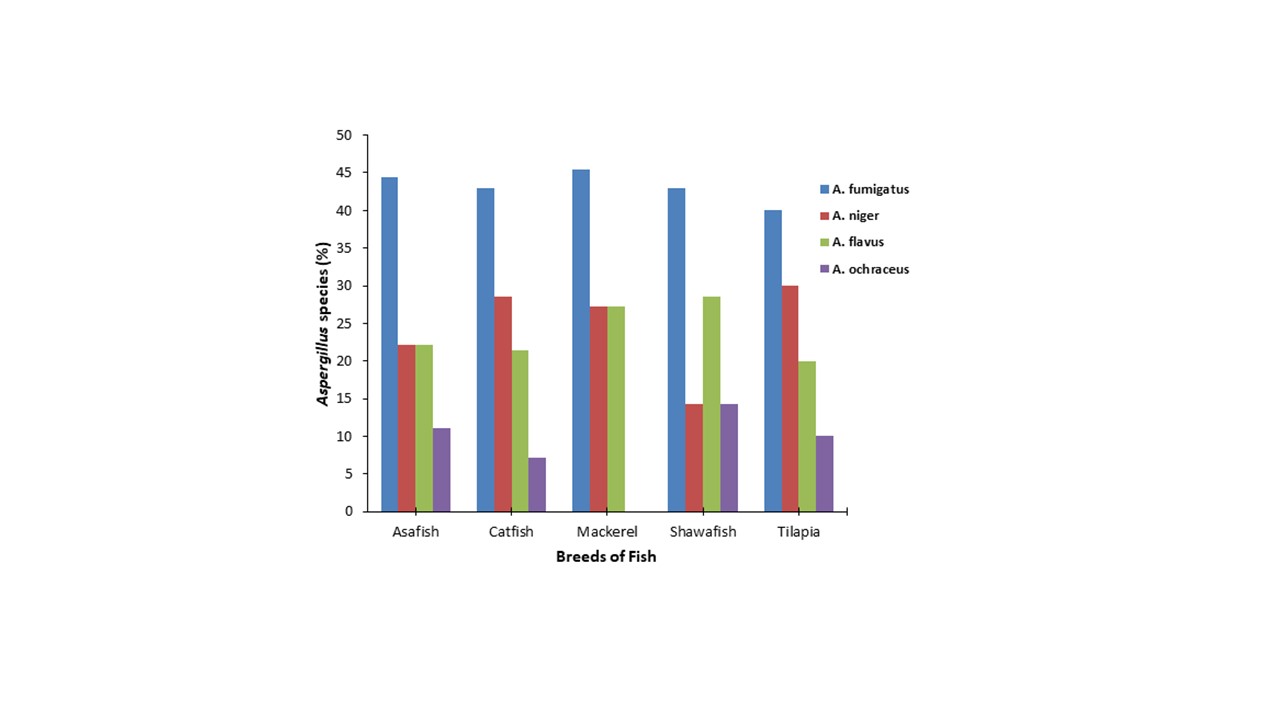
Consumption of smoked and smoke-dried fish is common in Nigeria as smoking is one of the common methods of preserving fish. Sadly, due to unhygienic handling and processing techniques, coupled with poor storage facilities and sanitary conditions in the market environments, majority of the fish sold in markets are laden with fungal contaminants of the genus, Aspergillus. The purpose of this study was to determine the prevalence of Aspergillus species among the smoke-dried fish sold in Uyo markets. A total of 360 samples of smoke-dried fish from five breeds of fish were randomly collected from six Uyo markets for study. The samples were aseptically cultured and assayed for the presence of Aspergillus species in Obong University Microbiology Laboratory. Each of the fish samples was blended and 1g suspended in 9ml of sterile distilled water, and 10-fold serial dilutions were made to produce graded concentrations ranging from 10-1 to 10-9. About 1ml of each dilution was spread on the surfaces of triplicate potato dextrose agar plates supplemented with 0.05 mg/ml of chloramphenicol and gentamicin and incubated at 25 ± 2°C for 7 days. Representative colonies of Aspergillus species on PDA were sub-cultured on sterile PDA plates to obtain pure colonies, and were further confirmed by microscopic examination. The microbial colonies in each plate were counted and the average number of colonies in the triplicate was calculated. Out of the 360 samples collected, Aspergillus was isolated from 51 samples, resulting in a prevalence of 14.2%. Four species of Aspergillus isolated from this study were 22 isolates of A. fumigatus, 13 isolates of A. niger, 12 isolates of A. flavus and 4 isolates of A. ochraceus. A. fumigatus was the most encountered species of Aspergillus in each market while A. ochraceus was the least. Urua Ekpa market had the highest number of isolates of Aspergillus species, with 12 isolates, followed by Itam market with 10 isolates. According to the order of magnitude, catfish was the most contaminated fish samples, followed by mackerel (Titus), tilapia, Asa fish and finally, Shawa fish. The result also revealed the rich microbial population of Aspergillus species from the various breeds of fish samples with mean values ranging from 1.9 x 10² cfu/g to 2.4 x 10² cfu/g. The result obtained from this study shows that a lot of fish sold in Uyo markets are contaminated with Aspergillus fungi which are opportunistic pathogens of public health importance. Therefore, to cub the menace of aspergillosis in Akwa Ibom state and possibly in Nigeria at large, fish contaminations should be avoided by employing appropriate professional techniques of fish processing and storage. This is the first systematic report on the prevalence and diversity of Aspergillus species in smoke-dried fish sold in Uyo, Akwa Ibom State. It provides baseline data for surveillance of fungal contamination in smoked fish and highlights the need for improved food hygiene in Uyo markets.
References
Adeyeye, S. A. O. (2016). Quality and safety assessment of sun-dried meat product (kundi) from Ibadan, Oyo state, Nigeria. Cogent Food & Agriculture. 2(1). https://doi.org/10.1080/23311932.2016.1209074
Aduly, Z. R´, Szab L. ´O, Madar A. & P´ocsi I., Csernoch L. (2020). Toxicological and medical aspects of aspergillus-derived mycotoxins entering the feed and food chain, Front. Microbiol. 10: 2908.
Agnew, D. J., Pearce, J., Pramod, G., Peatman, T., Watson, R., Beddington, J. R. & Pitcher, T. J. (2009). Estimating the worldwide extent of illegal fishing. Retrieved from http://www.plosone.org-/article/info:doi/10.1371/journal.pone.0004570.Accessed 31th March, 2015.
Akande, G. & Tobor, J. (2012). Improved Utilization and Increased Availability of Fishing Products as an Effective Control of Aggravated Animal Protein Deficiency Induced Malnutrition in Nigeria. Proceedings of the 10th Annual Conference of the Fisheries Society of Nigeria, 18-31.
Akwuobu, C.A., Antiev, W.S. & Ofukwu, R.A.P. (2019). Fungal contaminants of smoke-dried fish sold in open markets in Makurdi, Benue State, north-central Nigeria. Nutrition and Food Science, 10:290-297.
Almeida I. F., Martins H. M. L., Santos S. M. O., Freitas M. S, da Costa J. M. G. N. & D´Almeida Bernardo F. M. (2011). “Mycobiota and aflatoxin B1 in feed for farmed sea bass (Dicentrarchus labrax),” Toxins, vol. 3, no. 3, pp. 163–171.
Alshannaq, A. & Jae-Hyuk, Y. (2017). A review: Occurrence, toxicity, and analysis of major mycotoxins in food. Int. J. Environ. Res. Public Health, 14: 1-20.
Anosike, I. K., Egbomuche, R. C., Etang, U. E., Akpan, N. G., & Abasiubong, V. N. (2024). Prevalence and antibiotic susceptibility pattern of Streptococcus pneumoniae amongst residents of Obong Ntak in Etim Ekpo Local Government of Akwa Ibom State, Nigeria. Journal of Basics and Applied Sciences Research, 2(1), 208–216.
Aristil, J., Giovanni, V. & Alberto, S. (2017). Occurrence of toxigenic fungi and aflatoxin potential of Aspergillus spp. strains associated with subsistence formed crops in Haiti. J. Food Protections, 80 (4): 626-631.
Ayuba, V.O., Alhassan, M. & Jimmy, U. (2013). Assessment of the Microbial Load of Smoked Sardine (Sardina pilchardus, Walbaum, 1792) Sold in Makurdi Markets. International Journal of Current Microbiology and Applied Sciences, 2, 277-287.
Baker J. L., Bayman P., Mahoney N.E., Klich M.A., Palumbo J.D. & Campbell B.C. (2003). Ochratoxigenic A. lanosusand A. alliaceus isolates from California tree nut orchards, in: Proceedings of the 3rd Fungal Genomics, 4th Fumonisin, and 16th Aflatoxin Elimination Workshops, Savannah, Georgia.
Begum M., Akter, Ahmed, & Md, (2011). Evaluation of quality and storage stability of commercially produced dried fish of Tengra (Mystus vittatus) with laboratory produced dried fish products. International Journal of Bio-resource and Stress Management. 2(2), 246-2494.
Benedict, A.G., Ikeh, M.I., Okonkwo, V.O., Okeke, O.A., Danjuma, B.J. & Ishar, C.O. (2023). A survey of gastrointestinal helminth parasites and haemoparasites of Tilapia zilli in Anambra east local government area of Anambra State.South Asian Journal of Parasitology, 7(1):12-18.
Caroline, B., Alexandria, D., Luisa, G. L., Michelle, M. & Marin, T. B. (2021). Azole-resistant Aspergillus fumigatus in the environment: Identifying key reservoirs and hotspots of antifungal resistance. PLoS Pathog. 17(7): e1009711. doi: 10.1371/journal.ppat.1009711.
Chauhan, R. (2013). Studies on Conidial Fungi Isolated from Some Fresh Water Fishes. International Journal of Advance Life Sciences (IJALS). 6 (4): 277 – 281.
Daramola, J. A., Alao, F. O. & Adeniyi, A. E. (2020). Estimation of bacteria and fungi in smoked catfish (Clarias gariepinus) available in Ota markets. Journal of Research in Forestry, Wildlife & Environment, 12(2): 65- 73.
Davies A. A., Adekoya, A. O., Balogun, O. J., Osaigbovo, I. I., Augustina, N., Titilola, G., Olubunmi, O., Jean-Pierre, G. & Rita O. O. (2024). Prevalence of Chronic Pulmonary Aspergillosis in Two (2) Tuberculosis Treatment Clinics in Lagos, Nigeria: A Prospective Longitudinal Study. Open Forum Infectious Diseases-https://doi.org/10.1093/ofid/ofae090
de Massaguer, P.R, da Silva A.R, Chaves R.D. & Gressoni Jr. I. (2014). Fruits and Vegetables/ Fruit and Vegetable Juices. Encyclopedia of Food Microbiology (2nd Edition). Pages 992 - 999.
Deryck, D. P. (2006). Aspergillus, Health Implication & Recommendations for Public Health Food Safety. Internet Journal of Food Safety, Vol.8, 2006, p. 19-23
Ekpenyong R E, Etim E M, Ekpenyong R, Shaibu M. E, & Etim E (2020). Geospatial Analysis and Assessment of the Distribution of Petrol Stations in Uyo Capital City, Nigeria to Safeguard Human and Environmental Health. International Journal of Social Sciences. Vol. 13, No. 2.
Fallah, A. A., Pirali-Kheirabadi, E., Rahnama, M., Saei-Dehkordi, S. S. & Pirali-Kheirabadi, K. (2014). Mycoflora, afla-toxingenic strains of Aspergillus section flavi and aflatoxins in fish feed. Quality Assurance Safety Crop Foods, 6: 419-424.
Gonçalves, R.A., Naehrer, K. & Santos, G.A. (2018). Occurrence of mycotoxins in commercial aquafeeds in Asia and Europe: a real risk to aquaculture? Rev. Aquac. 10 (2), 263–280. https://doi.org-/10.1111/RAQ.12159.
Gonkowski S., Obremski, M. & Rytel, (2018). Levels of zearalenone and its metabolites in sun-dried kapenta fish and water of Lake Kariba in Zambia-A preliminary study The Science of the Total Environment growth: the effect of water activity on Aspergillus flavus and related species. International Journal of Food Microbiology 23, 419–431. https://doi.-org/10.1016/0168- 1605(94)-90167-8
Hassan, A. A., Hassan, M. A., El Shafei, H. M., El Ahl, R. M. H. S. & El-Dayem, R. H. Abd. (2011). Nature and Science, 9(9): 106.
Heussner, A., Bingle, L., Heussner, A. H. & Bingle, L. E. H. (2015). Comparative Ochratoxin Toxicity: a review of the available data. Toxins 7, 4253–4282. doi: 10.3390/toxins7104253.
Hungerford, L., Campbell, C. & Smith, A. (1998). Common Opportunistic or Contaminant Fungi. In: Veterinary Mycology Laboratory Manual, Iowa State University Press, Iowa, 58-60.
Ike, C.C., David, A.C., Ogwuegbu, H.O. & Akwari, D.K. (2020). Fungal profile associated with spoilage of smoked catfish sold in Aba, Abia state, Nigeria. GSC Biological and Pharmaceutical Sciences, 10(3):110-117.
Ikeh M. I., Ishar C. O., Chiakwelu P. C., Okeke O. A., Okeke C. J, Offor V. O., Obiakor U. A., Oraneli U. B. & Benedict A. G. (2024). Study of Fungal Organisms Associated with Smoked and Dried Fish Sold in Awka Markets, Anambra State. African Journal of Agriculture and Food Science. Volume 7, (4): 87-98
Ikutegbe, V. & Sikoki, F. (2014). Microbiological and biochemical spoilage of smoked-dried fishes sold in west African open market. Food Chemistry, 161:332-336.
Job, M. O. S., Agina, S. E & Dapiya, H. S. (2061). Occurrence of Aflatoxigenic Fungi in Smoke dried Fish Sold in Jos Metropolis. British Microbiology Research Journal, 11(1): 1-7.
John, W. C., Buba, B. A., Ayisa, T. T., Oke, O., Ihum, T.A. & Ishaya, M. (2020). Mycological examination of smoke-dried fish sold in Bida major markets. European Journal of Biology, 5(1): 28-40.
Jonathan S.G. & Esho E.O. (2010). Fungi and Aflatoxin detection in two oyster mushrooms Pleurotus ostreatus and Pleurotus pulmonarius from Nigeria. Electronic Journal of Environmental, Agricultural and Food Chemistry, 9, 1722–1730
Koteswara Rao V., Shilpa P., Girisham S. & Reddy S. M. (2016) Incidence of mycotoxigenic penicillia in feeds of Andhra Pradesh, India. Int. J. Biotechnol. Mol. Biol. Res. 2; 46–50.
Lewis, L., Mary, O., Henry, N., Helen, S., George, L., Stephanie, K., Jack, N., Lorraine, B., Abdikher, M. D., Ambrose M., Kevin, D., Carol, R. & the Kenya Aflatoxicosis Investigation Group (2005). Aflatoxin Contamination of Commercial Maize Products during an Outbreak of Acute Aflatoxicosis in Eastern and Central Kenya. Environmental Health Perspectives, Vol. 113, No. 12.
Liti D., Cherop L., Munguti J. & Chhorn L. (2005). “Growth and economic performance of Nile tilapia (Oreochromis niloticus L.) fed on two formulated diets and two locally available feeds in fertilized ponds,” Aquaculture Research, vol. 36, no. 8, pp. 746–752.
Madigan, T. M., Martinko, J. M. & Stahl, D. (2009) Brock Biology of Microorganisms. Person International Incorporation Publishers, San Francisco.
Mousavi, B. Hedayati, M.T. Hedayati, N. Ilkit, M & Syedmousavi, S. (2016). Aspergillus species in indoor environments and their possible occupational and public health hazards. Journal of Current Medical Mycology.2(1): 36–42.
Ngo, H., Tran, L, Nguyen, D., Nguyen, T., Le Th. & Gao, Y. (2021). Metal Pollution and Bioaccumulation in the Nhue-Day River Basin, Vietnam: Potential Ecological and Human Health Risks. International Journal of Environmental Research and Public Health, 18(24):13425.
Ngo-oum, T.J., Fokom, R., Adamou, S., Biya-Bayema, F.J., Tomedi-Eyango, M. & Tchoubougnang, F. (2021). Smoke dried fish quality as affected by insect and fungal colonization within storage in urban markets in Cameroon. IOSR Journal of Agriculture and Veterinary Science, 14(6):45-53.
Odagboyi, G., Gberikon, G. M., Yaji, M. E. & Iwodi, C. (2024). Occurrence and Distribution of Aspergillus species among presumptive Tuberculosis Patient in Otukpo Local Government Area of Benue State, Nigeria UMYU Journal of Microbiology Research, 9(2), 48 – 54.
Ojutiku, R.O., Kolo, R. J. & Mohammed, M.L. (2009). Comparative study of sun drying and solar tent drying of Hyperopsius babeoccidentalis. Pakistan Journal of Nutrition, 8(7):955 - 957.
Oku, I. & Amakoromo, E. R. (2013). Microflora of fresh and smoke-dried fish in Yenagoa metropolis, Nigeria. African Journal of Microbiology Research. Vol. 7, No. 35, 4451 - 4456 ref. 14.
Onyeakagbu, A. (2021). "See how all the 36 Nigerian states got their names". Pulse.ng. Retrieved 22 December 2021.
Oparaku, N.F. & Mgbemena, B.O. (2012). Effects of electric oven and solar dryer on a proximate and water activity of Clarias gariepinus fish. European Journal of Science Research, 81(1): 139-144.
Oyebamiji, F. & Oyebimpe, F. (2013) Microbial Identification of Smoke-Dried Fish (Clarias gariepinus) from Some Local Markets in Ibadan Metropolis. Wudpecker Journal of Agricultural Research, 2, 294-298.
Pal, M. (2017). Morbidity and mortality due to fungal infections. J. App. Microbiology and Biochemistry; 1 (1): 1-3.
Patel, R., Hossain, A., German, N. & Alahmad, A. (2018). Gliotoxin penetrates and impairs the integrity of the human blood-brain barrier in vitro. Mycotoxin Res. 34, 257–268. doi: 10.1007/s12550-018-0320-7.
Pitt, I. J. & Hocking, A. D. (2009). Fungi and Food Spoilage. 3rd Edition, Springer Dordrecht Heidelberg London, New York Cambridge p519, https://doi.org/10.1007-/978-0-387-92207-2
Podeti, K. R.& Benarjee, G. (2015). Studies on Haematological and Histological Mycosis Varations of Channa punctatus (Bloch) found Infected with Asperigillus fumigatus and Aspergillus niger Spp Exhibited EUS Characteristics. World Journal Pharmacy and Pharma-ceutical Science. 4 (7): 1233 – 1246.
Raghda, A. E., Ali, B. J., Wenyi, K. & Fatma M. E. (2022). An overview on the major mycotoxins in food products: characteristics, toxicity, and analysis. Journal of Future Foods 2(2), 91-102
Resmila, D. (2018). Isolation and Identification of Aspergillus Species from Wooden Fish (Keumamah). International Journal of Microbiology and Application, 5(3), 27-35.
Rushing, B. R. & Selim, M. I. (2019). Aflatoxin B1: a review on metabolism, toxicity, occurrence in food, occupational exposure, and detoxification methods. Food Chem. Toxicol. 124, 81–100. doi: 10.1016/j.fct.2018.11.047.
Sani, F.M., Nasir, I.A. & Torhile, G. (2016). Mycological Evaluation of Smoked-Dried Fish Sold at Maiduguri Metropolis, Nigeria: Preliminary Findings and Potential Health Implications. European Journal of Health Sciences, 2, 5-10.
https://doi.org/10.5505/eurjhs.2016.69885.
Suanthie Y., Cousin M. A. & Woloshuk C.P. (2008). Multiplex real-time PCR for detection and quantification of mycotoxin-genic Aspergillus, Penicillium and Fusarium, J. Stored Prod. Res. 45 139–145.
Swaminathan, B. & Sparling, P. (1998) The Bacteriology of Food Excluding Dairy Products. In: Collier, L., Balows, A. and Sussman, M., Eds., Microbiology and Microbial Infection, 9th Edition, Edward Arnold Publishers Ltd., London, 2, 407-408.
Udovicki, B., Audenaert, K., De Saeger, S., & Rajkovic, A. (2018). Overview on the Mycotoxins incidence in serbia in the period 2004-2016. Toxins 10:279. doi: 10.3390/toxins10070279.
Varga, J., Nikolett, B., Muthusamy, C., Csaba, V. & Sandor, K. (2015). Mycotoxin producers in Aspergillus genus; an update. ActaBiol Szaged, 59 (2): 151-167.
World Health Organization (2015). The world is becoming a smaller place for microbes: Diseases affecting tourists. In: Removing Obstacles to Healthy Development. (Version current at September 8, 2003).
Downloads
Published
How to Cite
Issue
Section
License
Copyright (c) 2025 Researchers Journal of Science and Technology

This work is licensed under a Creative Commons Attribution-NonCommercial-NoDerivatives 4.0 International License.
Unless a different licence is clearly indicated for a particular article, articles published in the journal are made available under the Creative Commons Attribution 4.0 International (CC BY 4.0) licence. This licence permits others to read, download, copy, distribute, share, adapt, and build upon the published work, including for commercial purposes, provided that appropriate credit is given to the original author(s), the article is properly cited, and any changes made to the original work are clearly indicated.