An Enhanced Technology - Organization–Environment Framework for Academic Information System Adoption in Nigerian Universities
DOI:
https://doi.org/10.83080/rejost.vol6no2.264Keywords:
Technology–Organization–Environment, Academic Information Systems, PLS-SEM, Digital Literacy, Higher Education, Organizational SupportAbstract
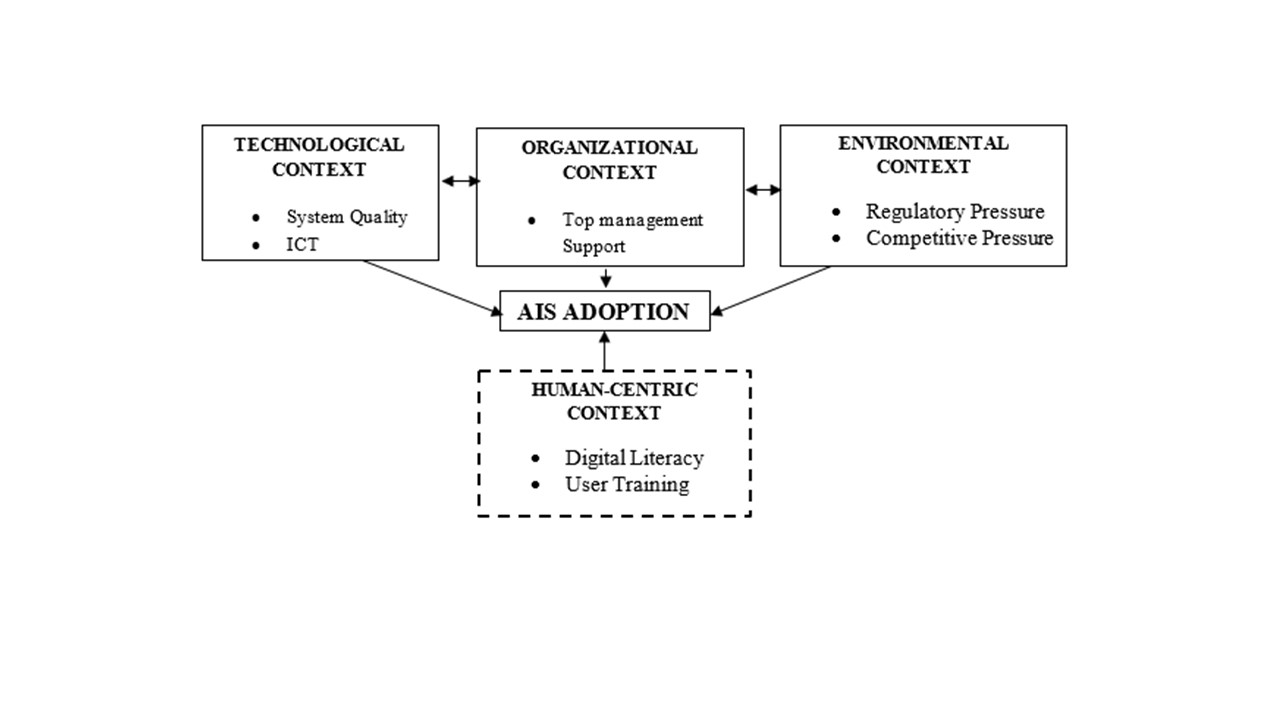
This study investigated the factors influencing the adoption of Academic Information Systems (AIS) in higher education institutions in Nigeria using an enhanced Technology–Organization–Environment (TOE) framework. Eight predictors were examined, namely: system quality, compatibility, top management support, IT human resources, regulatory pressure, peer institutional influence, user training, and digital literacy. Data were collected from 151 respondents through a structured questionnaire administered via Google Forms, using a five-point Likert scale ranging from “strongly disagree” to “strongly agree.” Partial Least Squares Structural Equation Modeling (PLS-SEM) in R was employed for data analysis. The results revealed that top management support (β = 0.314, p < 0.001), regulatory pressure (β = 0.465, p < 0.001), and digital literacy (β = 0.213, p = 0.003) were significant predictors of AIS adoption. Other factors, including system quality, compatibility, IT human resources, peer institutional influence, and user training, showed positive but statistically insignificant effects. The findings highlight that organizational support, regulatory requirements, and user capabilities are the primary drivers of AIS adoption, while technological factors showed limited influence. These results emphasize the importance of leadership engagement, compliance with external regulations, and enhancing users’ digital literacy to improve the successful adoption of AIS in higher education. This study extends prior TOE research by incorporating user-centric factors, addressing gaps in empirical studies on AIS adoption in Nigerian universities.
References
Acharya, K. (2024). School management system project report. SSRN Electronic Journal. https://doi.org/10.2139/ssrn.4-837837
Adade, D., & De Vries, W. T. (2024). An extended TOE framework for local government technology adoption for citizen participation: Insights for city digital twins for collaborative planning. Transforming Government: People, Process and Policy. https://doi.org/-10.1108/tg-01-2024-0025
Ahmed, A. A., Jinshuo, L., & Ezekia, G. (2024). Determinants of intention to adopt blockchain technology in Nigeria. Science World Journal, 19(2), 482–491. https://doi.org/10.4314/swj.v19i2.25
Bangladesh, A. L. Y. L. A.-D., & Khan, M. N. I. (2022). A systematic review of legal technology adoption in contract management, data governance, and compliance monitoring. American Journal of Interdisciplinary Studies, 3(1), 1–30. https://doi.org/10.63125-/caangg06
Cheung, G. W., Cooper-Thomas, H. D., Lau, R. S., & Wang, L. C. (2023). Reporting reliability, convergent and discriminant validity with structural equation modeling: A review and best-practice recommendations. Asia Pacific Journal of Management, 41(2), 745–783. https://doi.org/10.1007/s10490-023-09871-y
Chew, X., Atiyah, A. G., Alnoor, A., Abbas, S., Muhsen, Y. R., & Bayram, G. E. (2025). PLS-SEM path model estimation. In Information systems engineering and management (pp. 17–34). https://doi-.org/10.1007/978-3-032-01055-1_2
Ergado, A. A., Desta, A., & Mehta, H. (2021). Determining the barriers contributing to ICT implementation by using the technology–organization–environment framework in Ethiopian higher educational institutions. Education and Information Technologies, 26(3), 3115–3133. https://doi.org/10.1007/s10639-020-10397-9
Guenther, P., Guenther, M., Ringle, C. M., Zaefarian, G., & Cartwright, S. (2023). Improving PLS-SEM use for business marketing research. Industrial Mar-keting Management, 111, 127–142. https://doi.org/10.1016/j.indmarman.2023.03.010
Hadwer, A. A., Tavana, M., Gillis, D., & Rezania, D. (2021). A systematic review of organizational factors impacting cloud-based technology adoption using the technology–organization - environment framework. Internet of Things, 15, 100407. https://doi.org/10.1016/j.iot.2021.100407
Hair, J., & Alamer, A. (2022). Partial least squares structural equation modeling (PLS-SEM) in second language and education research: Guidelines using an applied example. Research Methods in Applied Linguistics, 1(3), 100027. https://doi.org/10.1016/j.rmal.2022.100027
Hartono, A., Roostika, R., & Muslichah, I. (2025). Investigating factors influen-cing decision makers to adopt accreditation information systems using multi-theory of technology acceptance model, resource dependence theory, and technology–organization–environment: Evidence from Indonesian private universities. International Review of Management and Marketing, 15(2), 132–145. https://doi.org/10.32479/irm-m.17931
Leoni, L., Ardolino, M., Baz, J. E., Gueli, G., & Bacchetti, A. (2022). The mediating role of knowledge management processes in the effective use of artificial intelligence in manufacturing firms. International Journal of Operations & Production Manage-ment, 42(13), 411–437. https//doi.org/-10.1108/ijopm-05-2022-0282
Madaki, A. S., Ahmad, K., & Singh, D. (2024). IT integration implementation in e-government public sector in developing countries: A systematic literature review and model development. Transforming Government: People, Process and Policy, 18(3), 451–472. https://doi.org/10.1108/tg-02-2024-0043
Nguyen, T. H., Le, X. C., & Vu, T. H. L. (2022). An extended technology–organization–environment (TOE) framework for online retailing utilization in digital transformation: Empirical evidence from Vietnam. Journal of Open Innovation: Technology, Market, and Complexity, 8(4), 200. https://doi.org/-10.3390/joitmc8040200
Ramachandran, K. M., & Tsokos, C. P. (2020). Empirical methods. In Elsevier eBooks (pp. 531–568). https://doi.org/10.10-16/b978-0-12-817815-7.00013-0
Russo, D., & Stol, K. (2021). PLS-SEM for software engineering research. ACM Computing Surveys, 54(4), 1–38. https-://-doi.org/10.1145/3447580
Saputri, A., & Mulyani, E. (2022). The impact of academic information systems on students’ satisfaction in higher education. Studies in Educational Management, 12, 1–9. https://doi.org/-10.32038/sem.2022.12.01
Stamate, A., Marzan, M., Velciu, M., Paul, C., & Spiru, L. (2024). Advancing user-centric design and technology adoption for aging populations: A multifaceted approach. Frontiers in Public Health, 12. https://doi.org/10.3389/fpubh.2024-.1469815
Sunarjo, R. A., Chakim, M. H. R., Maulana, S., & Fitriani, G. (2024). Management of educational institutions through information systems for enhanced efficiency and decision-making. Inter-national Transactions on Education Technology (ITEE), 3(1), 47–61. https://doi.org/10.33050/itee-.v3i1.670
Thelma, N. C. C., Welbeck, N. B. A., Sain, N. Z. H., Mpolomoka, N. D. L., Sylvester, N. C., & Phiri, N. E. V. (2024). The effect of management information systems on student academic performance: A case of selected higher learning institutions in Lusaka District, Zambia. World Journal of Advanced Research and Reviews, 24(3), 118–129. https://doi-.org/10.30574/wjarr.2024.24.3.3669
Wei, Z. (2023). Navigating digital learning landscapes: Unveiling the interplay between learning behaviors, digital literacy, and educational outcomes. Journal of the Knowledge Economy. https://doi.org/10.1007/s13132-023-01522-3
Downloads
Published
How to Cite
Issue
Section
License
Copyright (c) 2026 Researchers Journal of Science and Technology

This work is licensed under a Creative Commons Attribution-NonCommercial-NoDerivatives 4.0 International License.
Unless a different licence is clearly indicated for a particular article, articles published in the journal are made available under the Creative Commons Attribution 4.0 International (CC BY 4.0) licence. This licence permits others to read, download, copy, distribute, share, adapt, and build upon the published work, including for commercial purposes, provided that appropriate credit is given to the original author(s), the article is properly cited, and any changes made to the original work are clearly indicated.