Design, Fabrication, and Performance Evaluation of an Electric Abrasive Wheel Metal Cutting Machine for Small Workshop Applications
DOI:
https://doi.org/10.83080/rejost.vol6no4.293Keywords:
Abrasive wheel, Electric cutting machine, SME Fabrication, Energy Efficiency, Machine designAbstract
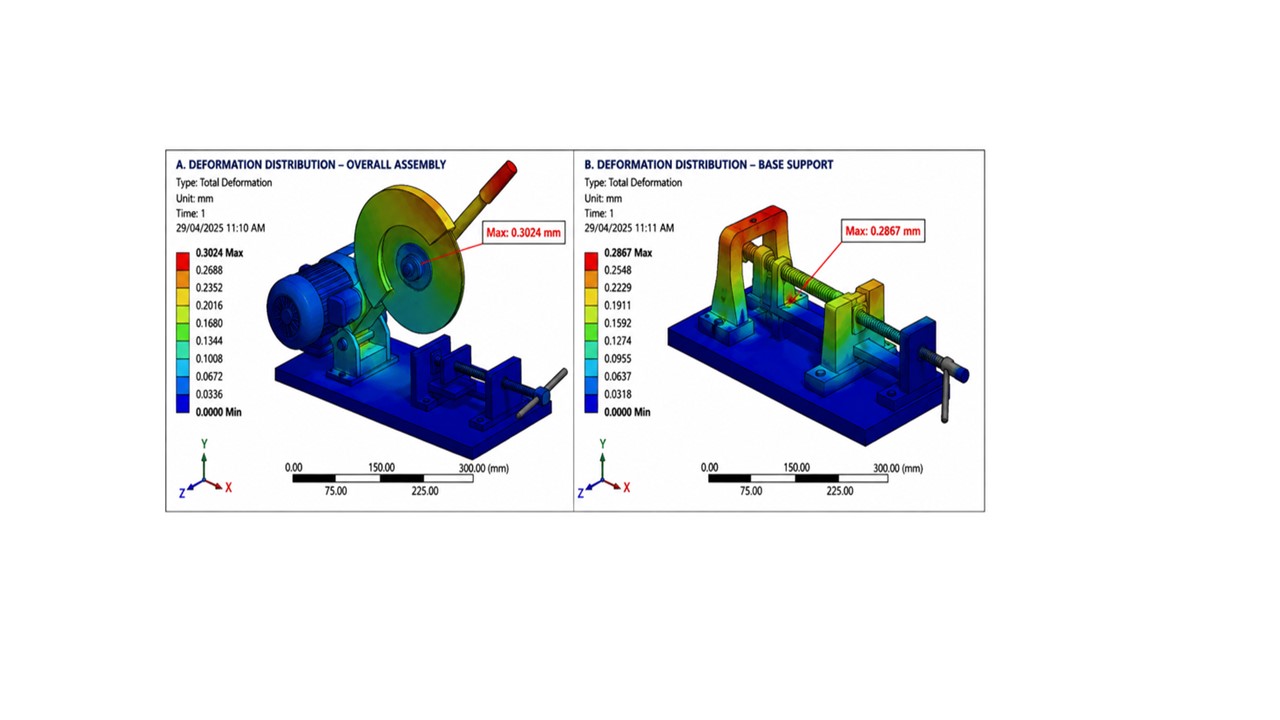
Demand for low-cost and energy-efficient metal-cutting machines in small and medium-scale industries is increasing, thereby prompting a need for an indigenous and adapted fabrication machine that can reduce the reliance on costlier foreign machines. Nearly all existing abrasive cutting machines are prohibitively expensive and energy-consuming as well as difficult to maintain in developing countries; however, no prior literature study has coupled engineering design with structural simulation, fabrication, and experimental validation of a suitable application for SMEs. Therefore, this project aimed at the design and fabrication of a low-cost, energy-efficient, and structurally stable electric abrasive-wheel-based metal cutting machine for workshop applications. The method of the study involves conceptualization, modeling using CAD, engineering calculations, selection of materials, Finite Element Analysis (FEA), fabrication and assembly of the machine, experimental analysis of its performance, and subsequent analysis of results obtained. Mild steel, cast iron, and aluminum were selected as the components of the machine based on strengths, vibration resistance, and corrosion resistance. Mild steel rods with diameters of 5, 10, 15, and 20 mm were used to determine the performance of the machine. The parameters studied were cutting time, rise in temperature, energy consumption, and vibration stability, as well as accuracy of the cutting operation. It was experimentally found that a rod of 20 mm in diameter of mild steel can be cut within 6 seconds. Regression analysis indicated that strong linear relation exists between thickness of material and cutting time ( = 0. 0.988) and between energy consumption and cutting time ( = 0. 0.997). The temperature rise study indicated the temperature of the grinding wheel reached a maximum of 57 °C, which is within operating safety limits, and stress distribution analysis from FEA indicated that stresses generated are much less than the yield strength of the materials chosen for designing each part. Also, the study showed that about a 60-75% reduction in fabrication cost was observed compared to imported machines.
References
ASTM, D. (2014). A36/A36M-08–Standard Specification for Carbon Structural Steel. or A992/A992M-06A, Grade 50–Standard Specification for Structural Steel Shapes.
ASTM International. (2021). ASTM A370-20: Standard test methods and definitions for mechanical testing of steel products. ASTM International.
Beer, F. P., Johnston, E. R., DeWolf, J. T. & Mazurek, D. F. (2015). Mechanics of Materials Seventh Edition. McGraw-Hill Education.
Budynas, R. G. & Nisbett, J. K. (2008). Shigley's mechanical engineering design (Vol. 8). New York: McGraw-Hill.
Duan, J., Cao, G., Ma, G., Yu, Z. & Shao, C. (2024). Research on online monitoring of grinding wheel wear based on multi-sensor fusion. Sensors, 24(18), 5888.
Fu, X., Lv, L., Chen, B., Deng, Z. & Wu, M. (2024). Pre-control of grinding surface quality by data-driven: A review. The International Journal of Advanced Manufacturing Technology, 133(7), 3081–3104.
International Organization for Standardization. (2015a). ISO 12100:2010: Safety of machinery - General principles for design - Risk assessment and risk reduction. ISO.
International Organization for Standardization. (2015b). ISO 16089:2015: Machine Tools - Safety-Stationary grinding machines. ISO.
Jamshidi, H. & Budak, E. (2024). A digital twin-based framework for selection of grinding conditions towards improved productivity and part quality. Journal of Intelligent Manufacturing, 35(1), 161–173.
Jiang, Q. & Song, J. (2026). A review on cutting force and thermal modeling, toolpath planning, and vibration suppression for advanced manufacturing. Machines, 14(1), 60.
Khurmi, R. S. & Gupta, J. K. (2005). A textbook of machine design. S. Chand Publishing.
Kuppuswamy, R., Jani, F., Naidoo, S. & de Jongh, Q. (2021). A study on intelligent grinding systems with an industrial perspective. The International Journal of Advanced Manufacturing Technology, 115(11), 3811–3827.
Li, C., Lv, L., Fu, X., Deng, Z., Ge, J. & Zhuo, R. (2025). Data-driven-based intelligent grinding process system: Construction strategies and applications. Journal of Intelligent Manufacturing, 1–28.
Lopes, W. N., Aguiar, P. R., Dotto, F. R. L., Junior, P. O. C., Viera, M. A. A., Fernandez, B. O. & Bianchi, E. C. (2021). Method for fault detection of aluminum oxide grinding wheel cutting surfaces using a piezoelectric diaphragm and digital signal processing techniques. Measurement, 180, 109503.
Mohamed, A., Hassan, M., M’Saoubi, R. & Attia, H. (2022). Tool condition monitoring for high-performance machining systems—A review. Sensors, 22(6), 2206.
Pan, M., Zhang, G., Zhang, W., Zhang, J., Xu, Z. & Du, J. (2024). A review of intel-ligentization system and architecture for ultra-precision machining process. Processes, 12(12), 2754.
Park, H. S. & Tran, N. H. (2024). A hybrid model-based autonomous system for controlling double side grinding process. International Journal of Precision Engineering and Manufacturing-Smart Technology, 2(2), 191–208.
Pervez, M. R., Ahamed, M. H., Ahmed, M. A., Takrim, S. M. & Dario, P. (2022). Autonomous grinding algorithms with prospects towards SMART manufacturing: A comparative survey. Journal of Manufacturing Systems, 62, 164–185.
Pimenov, D. Y., da Silva, L. R. R., Kuntoğlu, M., Abrão, B. S., dos Santos Paes, L. E. & Linul, E. (2025). Review of advanced sensor system applications in grinding operations. Journal of Advanced Research, 77, 371 – 405. https://doi.org/-10.1016/j.jare.2025.01.013.
Rajagopal, S. & Prabadevi, B. (2022). A review on advanced monitoring and identifying the status of the grinding machine using machine learning algorithms. ECS Transactions, 107(1), 1327.
Varghese, B., Pathare, S., Gao, R., Guo, C. & Malkin, S. (2000). Development of a sensor-integrated “intelligent” grinding wheel for in-process monitoring. CIRP Annals, 49(1), 231–234.
Wan, N., Wang, Z., Zhao, B., Ding,W. & Liu, Q. (2026). Intelligent evolution strategies for high-performance cutting tools: Status, challenges, and trends. International Journal of Extreme Manufacturing, 8(2), 022007.
Wang, J., Tian, Y., Hu, X., Fan, Z., Han, J. & Liu, Y. (2024). Development of grinding intelligent monitoring and big data-driven decision-making expert system towards high efficiency and low energy consumption: Experimental approach. Journal of Intelligent Manufacturing, 35(3), 1013–1035.
Downloads
Published
How to Cite
Issue
Section
License
Copyright (c) 2026 Researchers Journal of Science and Technology

This work is licensed under a Creative Commons Attribution-NonCommercial-NoDerivatives 4.0 International License.
Unless a different licence is clearly indicated for a particular article, articles published in the journal are made available under the Creative Commons Attribution 4.0 International (CC BY 4.0) licence. This licence permits others to read, download, copy, distribute, share, adapt, and build upon the published work, including for commercial purposes, provided that appropriate credit is given to the original author(s), the article is properly cited, and any changes made to the original work are clearly indicated.