Influence of Fertilizer Regimes on the Antioxidant and Hepatic Biochemical Effects of Corchorus olitorius in Potassium Bromate-Challenged Wistar Rats
DOI:
https://doi.org/10.83080/rejost.vol6no8.339Keywords:
Corchorus olitorius, Potassium bromate, Antioxidant enzymes, Fertilizer regimeAbstract
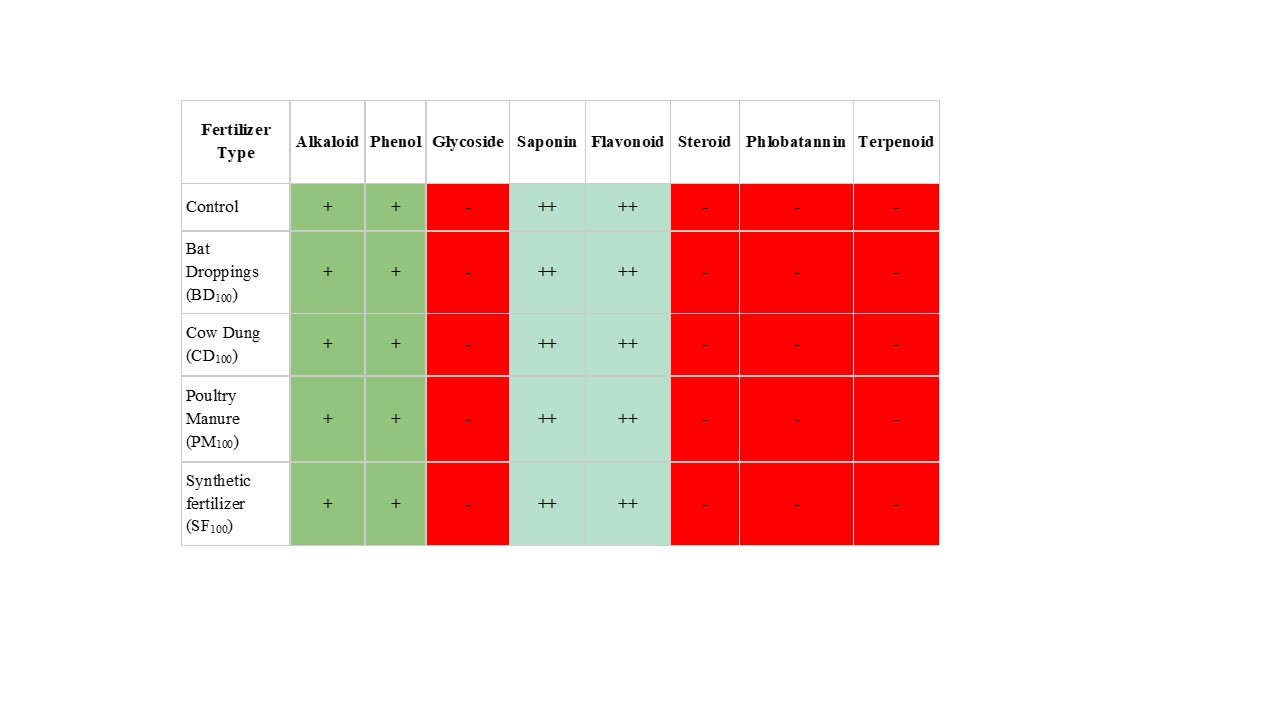
This study evaluated whether fertilizer regimes modify the biochemical and physiological effects of Corchorus olitorius leaf diets in potassium bromate (KBrO₃)-challenged Wistar rats. Forty-two male rats were assigned to seven groups (n = 6): negative control, KBrO₃ positive control, untreated C. olitorius, and leaves cultivated with bat dung (BD100), cow manure (CM100), poultry manure (PM100), or synthetic fertilizer (SF100). Fertilizer treatment significantly altered leaf proximate composition, with crude protein increasing from 22.10% in untreated leaves to 24.96, 24.92, and 24.30% in BD100-, PM100-, and SF100-treated leaves, respectively, whereas qualitative phytochemical profiles were similar across treatments. Rats received a single oral dose of KBrO₃ (100 mg/kg body weight), followed by 28 days of diets containing 20% leaf powder. Body weight, serum and hepatic oxidative-stress markers, antioxidant indices, and liver-function parameters were determined. KBrO₃ reduced final body weight by 12.9%, from 135.22±4.11 g in the negative control to 117.84±7.20 g in the positive control (p < 0.05). Relative to the positive control, SF100 and CM100 increased body weight by 10.3 and 9.4%, respectively, reaching 129.97±2.06 and 128.86±3.42 g (p < 0.05). Serum MDA and SOD did not differ significantly among KBrO₃-treated groups (p > 0.05). However, SF100 increased serum GSH by 11.6%, from 54.41±6.41 to 60.71±9.57 µmol/mL (p < 0.05), while CM100 increased hepatic SOD activity by 37.4%, from 59.21±6.50 to 81.38±9.26 U/mg protein (p < 0.05). SF100 increased hepatic CAT activity by 7.0%, although this difference was not significant relative to the positive control. GGT, total bilirubin, and direct bilirubin decreased by 41.1, 25.5, and 23.8%, respectively, in the SF100 group, but these changes were not statistically significant (p > 0.05). Conversely, SF100 increased ALT, AST, and ALP by 81.6, 40.8, and 23.8%, respectively (p < 0.05). The biological responses varied according to the fertilizer treatment. These findings indicate that fertilizer regimes modified the biological responses associated with consumption of C. olitorius leaves, particularly body-weight maintenance and selected antioxidant indices.
References
Agu, S. T., Alabi, A. A., Meshioye, D. O., Gbadegesin, M. A., & Odunola, O. A. (2023). Effects of potassium bromate on Rattus norvegicus brain antioxidant markers, acetylcholinesterase activity, and DNA fragmentation: investigation of therapeutic effect of Allium cepa. The Journal of Basic and Applied Zoology, 84(1), 12. https://doi.org/10.1186/-s41936-023-00333-x.
Ahmad, M. K., & Mahmood, R. (2012). Oral administration of potassium bromate, a major water disinfection by-product, induces oxidative stress and impairs the antioxidant power of rat blood. Chemosphere, 87(7), 750-756. https://-doi.org/10.1016/j.chemosphere.2011.12.073
Airaodion, A. I., Ogbuagu, E. O., Ogbuagu, U., Adeniji, A. R., Agunbiade, A. P., & Airaodion, E. O. (2019). Hepatoprotective Effect of Parkia biglobosa on Acute Ethanol-induced Oxidative Stress in Wistar Rats. International Research Journal of Gastroenterology and Hepatology, 2(1), 18-28. https://journalirjgh.com/index-.php/IRJGH/article/view/9
Ajarem, J., Altoom, N. G., Allam, A. A., Maodaa, S. N., Abdel-Maksoud, M. A., & Chow, B. K. (2016). Oral administration of potassium bromate induces neurobehavioral changes, alters cerebral neurotransmitters level and impairs brain tissue of swiss mice. Behav Brain Funct, 12(1), 14. https://doi.org-/10.1186/s12993-016-0098-8
Alege, G. O., Adehi, P. A., Musa, A. L., & Ossai, P. C. (2025). Effect of nutrient sources on the yield and phytochemical composition of jute mallow (Corchorus olitorius) cultivated using hydroponic and geoponic methods. Confluence Journal of Pure and Applied Science, 4(1), 15-34. https://cjpas.org.ng/index-.php/pub/article/view/83
Al-Mareed, A. A., Farah, M. A., Al-Anazi, K. M., Hailan, W. A. Q., & Ali, M. A. (2022). Potassium bromate-induced oxidative stress, genotoxicity and cytotoxicity in the blood and liver cells of mice. Mutation Research/Genetic Toxicology and Environmental Mutagenesis, 878, 503481. https://doi-.org/https://doi.org/10.1016/j.mrgentox.2022.503481
Al-Tamimi, J., Ebaid, H., Hassan, I., Rady, A., & Alhazza, I. (2026). Impact of Calotropis procera on potassium bromate-induced hepatotoxicity. Journal of King Saud University – Science, 38, 12592025. https://doi.org/10.25259/JK-SUS_1259_2025
Aminjan, H. H., Abtahi, S. R., Hazrati, E., Chamanara, M., Jalili, M., & Paknejad, B. (2019). Targeting of oxidative stress and inflammation through ROS/NF-kappaB pathway in phosphine-induced hepatotoxicity mitigation. Life Sciences, 232, 116607. https://doi.org/10.1016-/j.lfs.2019.116607
AOAC. (2023). Official Methods of Analysis of AOAC INTERNATIONAL (22nd ed.). Oxford University Press. https://doi.-org/10.1093/9780197610145.001.0001
Bayomy, N. A., Soliman, G. M., & Abdelaziz, E. Z. (2016). Effect of Potassium Bromate on the Liver of Adult Male Albino Rat and A Possible Protective Role of Vitamin C: Histological, Immunohistochemical, and Biochemical Study. The Anatomical Record, 299(9), 1256-1269. https://doi.org/10.1002/ar.2-3386
Das, A. K., Dewanjee, S., Sahu, R., Dua, T. K., Gangopadhyay, M., & Sinha, M. K. (2010). Protective effect of Corchorus olitorius leaves against arsenic-induced oxidative stress in rat brain. Environ Toxicol Pharmacol, 29(1), 64-69. https://doi.org/10.1016/j.etap.2009.10.002
Evans, W. C. (2009). Trease and Evans' Pharmacognosy: Sixteenth Edition.
Ewulo, B. S., Oboh, G., Adefegha, S. A., Oyeleye, I. S., Oluokun, O. O., & Ojo, O. R. (2025). Impact of elevated CO2 on yield, nutritional and medicinal properties of Corchorus olitorius. Vegetos, 38(3), 1029-1038. https://doi-.org/10.1007/s42535-024-00910-7
Halliwell, B., & Gutteridge, J. M. C. (2015). Free Radicals in Biology and Medicine. Oxford University Press. https://doi.org-/10.1093/acprof:oso/9780198717478.001.0001
Harborne, A. J. (1998). Phytochemical Methods: A Guide to Modern Techniques of Plant Analysis (3rd ed.). Springer. https://-link.springer.com/book/9780412572609
Höring, M., Krautbauer, S., Hiltl, L., Babl, V., Sigruener, A., Burkhardt, R., & Liebisch, G. (2021). Accurate Lipid Quantification of Tissue Homogenates Requires Suitable Sample Concentration, Solvent Composition, and Homogenization Procedure - A Case Study in Murine Liver. Metabolites, 11(6), 365. https://www.mdpi.com/2218-1989/11/-6/365
Kamel, A. H., Fouad, M. A., & Mohamed, H. A. (2023). Protective effect of aqueous extract of moringa oleifera leaves against potassium bromate - induced renal toxicity in rats. Egyptian Journal of Zoology, 79(79), 29 - 47.
Latif, R., & Nawaz, T. (2026). Medicinal plants and human health: a comprehensive review of bioactive compounds, therapeutic effects, and applications. Phytochemistry Reviews, 25(3), 2299-2342. https://doi.org/10.1007/-s11101-025-10194-7
Lugumira, R., Tafiire, H., Vancoillie, F., Ssepuuya, G., & Van Loey, A. (2025). Nutrient and Phytochemical Composition of Nine African Leafy Vegetables: A Comparative Study. Foods, 14(8), 1304.
Ma, B., Zheng, S., Xie, N., Yang, J., Zeng, X., Liu, P., Zhang, S., & Li, J. (2025). Metformin mitigates potassium bromate-induced liver grievance in rat through attenuating NF-kB and PI3K/Akt pathway. Electronic Journal of Biotechnology, 76, 1-11. https://doi-.org/10.1016/j.ejbt.2025.03.002
Mohamed, H. A. (2023). Protective effect of aqueous extract of moringa oleifera leaves against potassium bromate-induced renal toxicity in rats. Egyptian Journal of Zoology, 79(79), 29 - 47.
Nguyen, N. T. T., Nguyen, B. X., Habibi, N., Dabirimirhosseinloo, M., Oliveira, L. A., Terada, N., Sanada, A., Kamata, A., & Koshio, K. (2025). Effect of Organic and Synthetic Fertilizers on Nitrate, Nitrite, and Vitamin C Levels in Leafy Vegetables and Herbs. Plants (Basel), 14(6). https://doi.org/10.3390/plants14-060917
Ogidi, O. I., & Omabemituale, I. F. (2025). Biochemistry of Drug Metabolism: A Review. Quantum Journal of Medical and Health Sciences, 4(4), 16 - 34. https://doi.org/10.55197/qjmhs.v4i4.171
Radwan, S. A., El Wessemy, A. M., & Abdel-Aziz, B. F. A.-B., Enas S. (2022). Study the protective effect of vitamin E against potassium bromate toxicity on some hematological, renal, and hepatic functions in male rats. Bulletin of Pharmaceutical Sciences Assiut University, 45(2), 903-913. https://doi.-org/10.21608/bfsa.2022.271769
Saliu, J. A., Ademiluyi, A. O., Boligon, A. A., Oboh, G., Schetinger, M. R. C., & Rocha, J. B. T. (2019). Dietary supplementation of jute leaf (Corchorus olitorius) modulates hepatic delta-aminolevulinic acid dehydratase (δ-ALAD) activity and oxidative status in high-fat fed/low streptozotocin-induced diabetic rats. Journal of Food Biochemistry, 43(8), e12949. https://-doi.org/10.1111/jfbc.12949
Sofowora, A. (2008). Medicinal Plants and Traditional Medicine in Africa (3rd ed.). Spectrum Books.
Ting, L., Li, S., Yubin, Z., Yonglin, W., & Jiang, Z. (2021). Imbalanced GSH/ROS and sequential cell death. Journal of Biochemical and Molecular Toxicology, 36(1). https://doi.org/10.1002/jbt.22942
Umemura, T., Kitamura, Y., Kanki, K., Maruyama, S., Okazaki, K., Imazawa, T., Nishimura, T., Hasegawa, R., Nishikawa, A., & Hirose, M. (2004). Dose-related changes of oxidative stress and cell proliferation in kidneys of male and female F344 rats exposed to potassium bromate. Cancer Science, 95(5), 393-398. https://doi.org/-10.1111/j.1349-7006.2004.tb03221.x
Verardi, A., Sangiorgio, P., Della Mura, B., Moliterni, S., Spagnoletta, A., Dimatteo, S., Bassi, D., Cortimiglia, C., Rebuzzi, R., Palazzo, S., & Errico, S. (2025). Tenebrio molitor Frass: A Cutting-Edge Biofertilizer for Sustainable Agriculture and Advanced Adsorbent Precursor for Environmental Remediation. Agrono-my, 15(3), 758.
Zvinorova, P. I., Lekhanya, L., Erlwanger, K., & Chivandi, E. (2015). Dietary effects of Moringa oleifera leaf powder on growth, gastrointestinal morphometry and blood and liver metabolites in Sprague Dawley rats. Journal of Animal Physiology and Animal Nutrition, 99(1), 21-28. https://doi.org/https://doi.org/10.1111/jpn.12182
Downloads
Published
How to Cite
Issue
Section
License
Copyright (c) 2026 Emmanuel O. Ajani, Ibrahim M. Pogi, Raliat A. Aladodo, Sodeeq O. Abubakar, Rasheedat A. Adejare, Anifat A. Bello

This work is licensed under a Creative Commons Attribution-NonCommercial-ShareAlike 4.0 International License.
Unless a different licence is clearly indicated for a particular article, articles published in the journal are made available under the Creative Commons Attribution 4.0 International (CC BY 4.0) licence. This licence permits others to read, download, copy, distribute, share, adapt, and build upon the published work, including for commercial purposes, provided that appropriate credit is given to the original author(s), the article is properly cited, and any changes made to the original work are clearly indicated.